Until this fall, I had always been taught that the three most important factors of leadership were realizing problems and effectively solving them as quickly as possible, and overall, being confident in your solution. Essentially, I viewed leadership as a person in power meant to fix problems as they appeared. Leadership was an unwavering and static concept to me. Through the introduction of concepts such as ethical relativism vs. moral absolutism, adaptive vs. technical problems, and Cronon’s essay on the liberally educated, I’ve come to understand that there are two major houses of leadership, effective and ethical. Effective being that the goal is to complete the task, regardless of outside factors, whereas, the goal of ethical leadership is to work towards something better, whether that be a better society or a better solution. Through discussions of these houses of leadership, I have concluded that ethical leadership is inherently better and in the end, move effective.
In William Cronon’s “The Goals of a Liberal Education”, he outlines the goals of education which can then be connected with the virtues of a leader. Two of his main assertions are that liberally educated people, or in our case leaders, should be able to “talk with anyone” and that they should be able to actively listen and understand. These two ideas go hand in hand when addressing a problem. First, it is essential as leaders, that all groups of people feel comfortable confiding in us to initially diagnose a problem. However, the second part being actively listening and understanding is even more crucial to ethical leadership. With the most important word being “understanding”. As leaders, it is important to not only understand the problem, but also the ideologies sustaining the problem. This is where the concepts of adaptive vs. technical problems come into play. Adaptive problems are complex problems that are sustained by underlying principles, whereas, technical problems are more on the simple side and are not supported by underlying beliefs. Working to understand and find a solution that addresses the whole problem and not just the surface problem, is the mark of an ethical leader. While it is not guaranteed that an effective leader will only give technical solutions to an adaptive problem, but because of the difference in goals it is more likely for the ethical leader to work towards creating a solution that betters the situation, no matter the amount of time is necessary. It is important to note that these two types of leadership are not mutually exclusive however, they are distinct.
Concerning the role of adaptive problems in leadership, there are two ways to address the underlying beliefs and morals sustaining a problem. There is the cultural relativist approach which entails accepting the morals for what they are and reserving judgments. There is also the moral absolutist approach which requires a more analytical approach and that then allows room for the absolutist to make a judgment. As a leader, it is important to respect many differing beliefs, however, the main goal is often to keep the peace. This requires making some type of judgment, but the key is to do so respectfully.
With my new understanding of what leadership is, comes a duty to be that kind of leader. After analyzing and learning about the different concepts that go into leadership, I feel that I am more prepared to be an ethical leader, working towards a change that I think the world needs. Before I can solve a problem, I need to understand how to look at it and once I understand the problem, I have to know the ways to approach the solution. Being a leader is not about the position or the confidence, but rather about how you listen to, understand, and approach the problems that come your way.
Category: LDR101
A reflection on Stacey Abrams’ September 11, 2019 speech at Agnes Scott College.
In 2018, Stacey Abrams was on the verge of being Georgia’s first Black woman governor. However, she lost the election. This did not affect her goals, but rather her journey towards accomplishing them. Since her loss, Abrams has established organizations focused on voter’s rights and the census in Georgia. During her speech, Abrams repeatedly reminded her audience that, “failure is not fatal [or] a flaw.” Through her speech and her explanation of her journey, it is clear that Abrams focuses less on the authoritative, governmental position and rather on leading through action. She made a point to emphasize, “leadership looks like me leading”. She works towards her goals of making every vote count by creating her organizations. Abrams also emphasizes that leaders should be connecting to all of their constituents and not only those most likely to vote for them. Leadership, based on Abrams’ speech, is doing the work to move towards your goals no matter your position and essentially is “standing up so other people have the courage to stand with you.”
During her speech, Abrams’ began to describe the challenges and goals for future leaders. Her main challenge is that leaders need to be able to compromise. This does not mean compromising values, but rather future leaders must learn other’s values to marry both sets of values and come to a solution. In politics, major political parties are not always in agreeance and compromise is essential to making the difference that our leaders were elected to make. In the end, Abrams’ message stressed that you should be involved in issues that matter to you and that as a leader, you have to be ready to persuade and connect with all people.
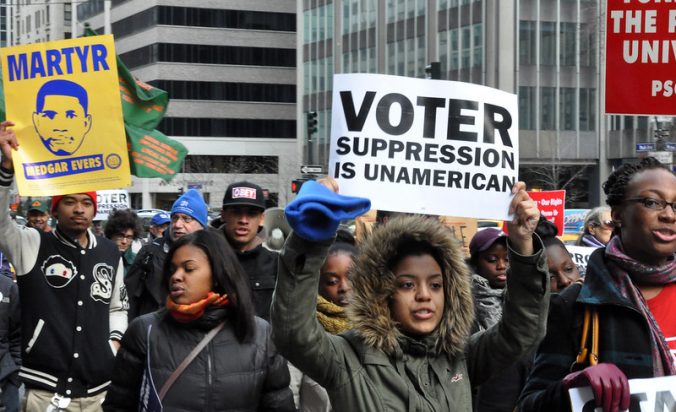
As an Agnes Scott student, I took the Strength Quest assessment. My strengths in order included connectedness, futuristic, belief, learner, and relator. I plan on using my strengths to assist me in tackling one of the issues that I am most passionate about, voter’s rights. My goal would be to address this problem through my campus. My first step would be to build a relationship through my connectedness and relator strengths with the officers of Ignite, a political club on campus. Becoming involved with a club and group of people whose ideas align with my own will help me begin to understand how to navigate political environments. Secondly, I want to start a chapter of the Andrew Goodman Foundation at Agnes Scott. It helps to promote voting: registering, voting, and being informed. Another strength of mine is strategic thinking. This will factor in when it comes to planning events that get my fellow students interested in being involved and in my ultimate goal, interested and informed about voting. At the end of my time at Agnes, I hope that I have encouraged other students to responsibly take part in our civil duties to move our nation forward.
Credit: “December 10 march for voting rights” by Michael Fleshman is licensed under CC BY-SA 2.0
